Powder mechanics · evidence summary
Model the clumps before choosing how to move the powder.
A team wants to handle a powder made of 500 nm silica spheres. Blowing gas through a powder bed can help expose the material for drying, coating or reaction, but these tiny particles stick together. The useful question is what the gas would actually move, which conditions could mobilise it, and whether vibration is worth testing. These are proposed industrial applications, not evidence of an existing customer deployment.
The research prompt
Original research prompt
create a model for fludiztion of silica 500 nm spheres powder; search for relevant open source program
Clumps, vibration, and the next experiment.
A 1,600-clump particle study explored vibration. A separate analytical model estimated a conditional gas-velocity range; the particle runs themselves contained no gas.
The particle runs contain no gas and their initial packing was still settling. Clump size is calibrated; this is not a validated fluidized-bed operating point.
The recorded investigation
Model the clump that the gas must move
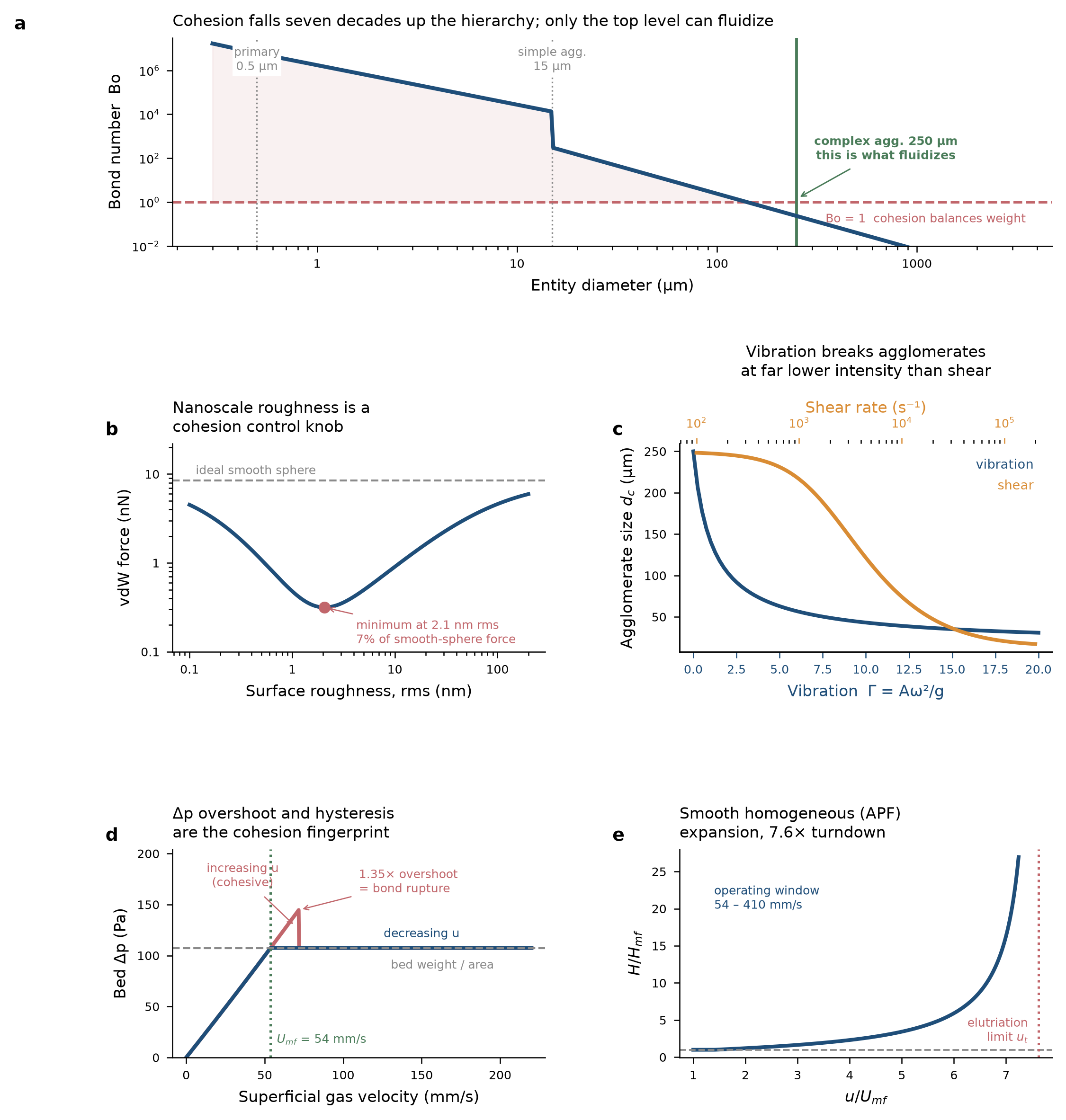
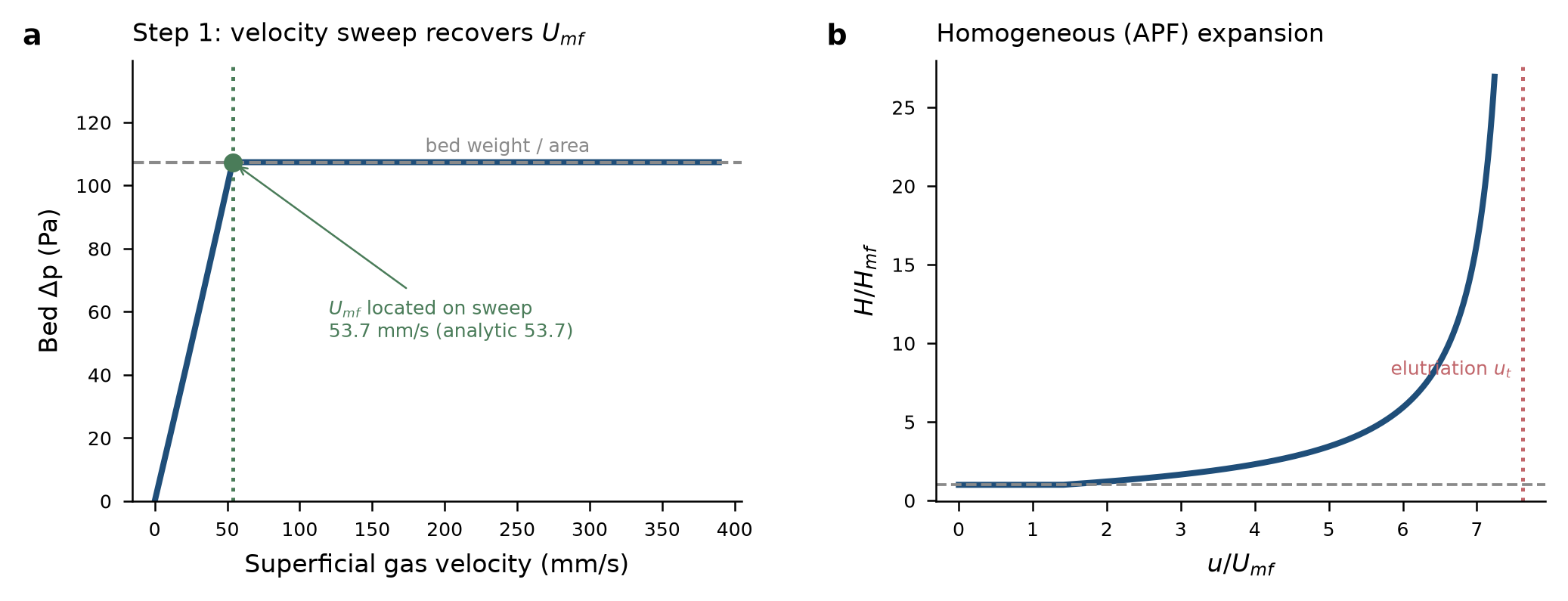
Under the stated dry-contact assumptions, adhesion between primary particles is about six million times a particle’s weight. Laplace therefore represented a hierarchy of clumps rather than treating every 500 nm sphere as freely dispersed. A fitted constant sets the larger clump diameter to 250 µm. Given that calibration, the model estimates fluidization onset near 53.7 mm/s and terminal velocity near 410 mm/s. The size is a calibration input, so the apparent operating window is a hypothesis to test.
Test contact separation with a second kind of model
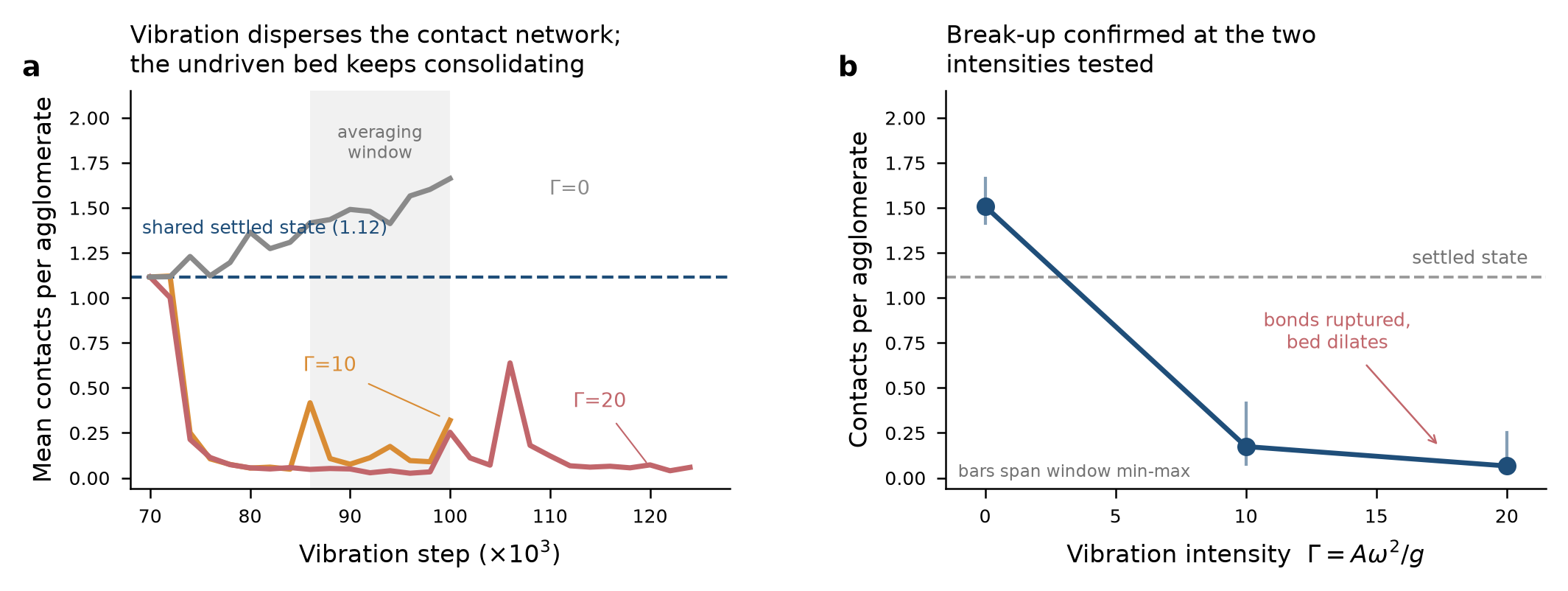
Laplace ran a LAMMPS study of 1,600 clumps, comparing no vibration with two imposed vibration intensities. In archived repeat-run traces, mean contact counts over the common window fall from 1.508 to 0.174 and 0.0666. This supports a vibration-dependent contact-separation trend in the simulated system. The calculation contains no gas and does not measure process throughput, coating quality or complete fluidization.
Use review to expose the assumption that controls the answer
The export contains a separate reproduction audit, a referee report and subsequent corrections. They expose missing model definitions, inconsistent numbers and a baseline that was still settling. The final report acknowledges that contact softening changes the physical contact regime and that the clump size is calibrated. Repeated simulation averages differ from the original run averages by 17–48% over different windows. The useful handoff is a model and a measurement plan with explicit limits, rather than a production setting.
Where the conclusion stops
- The 250 µm agglomerate diameter is a calibration target, not an independent prediction. The 53.7 mm/s onset and roughly 410 mm/s terminal velocity inherit that assumption. No experimental validation of this powder was performed.
- The LAMMPS runs contain no gas. They track contacts between rigid model agglomerates, not the internal fragmentation of 500 nm primary-particle clusters or a complete fluidized bed. MFiX and LIGGGHTS decks were generated but not executed or syntax-verified.
- The shared initial packing was still settling. Each vibration condition used one deterministic realisation in a small periodic box, with eight samples in the quoted window. The comparison does not isolate vibration from all initial-state effects or establish an industrial benefit.
- Contacts were softened from 70 GPa to 10 MPa for tractable time steps. The final report acknowledges a change in contact regime; preserving the chosen pull-off force does not validate the physical contact response.
- Original and repeated runs use different averaging windows; reported means differ by 17–48%. The record supports the trend and its scale, not precise reproducibility of every value.
- The archived audit and referee report concern an earlier draft. The final PDF incorporates corrections but retains inconsistent wording, including stronger network claims than its own sparse-packing limitation supports. The reproduced continuum table is not a clean audit pass of the entire final document.
- No measured human-hours saving, complete billing comparison, production throughput improvement or customer outcome is established. The recorded session span includes unknown waiting, compute and human interaction.
The next useful test
Measure the real powder’s clump size and pressure drop as gas velocity changes, while recording humidity. For a stronger vibration test, first settle the simulated packing to a stable baseline and examine contact-model and domain sensitivity. Then use coupled gas–solid simulation or a controlled bench test to check the proposed operating range.
Selected scientific files
These files support inspection of the study. They are not a complete package of run inputs, dependencies or raw outputs. Scientific scripts are provided for reading; this website does not execute them.
- dem_vibration_results.csv
- dem_window_check.csv
- driver.py
- fluidization_model.png
- ledger.csv
- reproduction_table.csv
- results.json
- silica_fluidization.py
- step1_tfm_sweep.png
- step2_dem_breakup.png
- tfm_velocity_sweep.csv
This is an editorial evidence summary of a recorded investigation, including later requests and review. The prompt animation is a presentation of saved work, not a live simulation. Human time saved was not measured.