Compressible flow · evidence summary
A longer run still fails the physics checks.
A difficult compressible-flow setup can tempt a team to invest in larger meshes before isolating the actual failure.
The research prompt
Original research prompt
use openfoam to do a RANS turbulence modeling of supersonic gas eductor
A diagnosis, with performance unresolved.
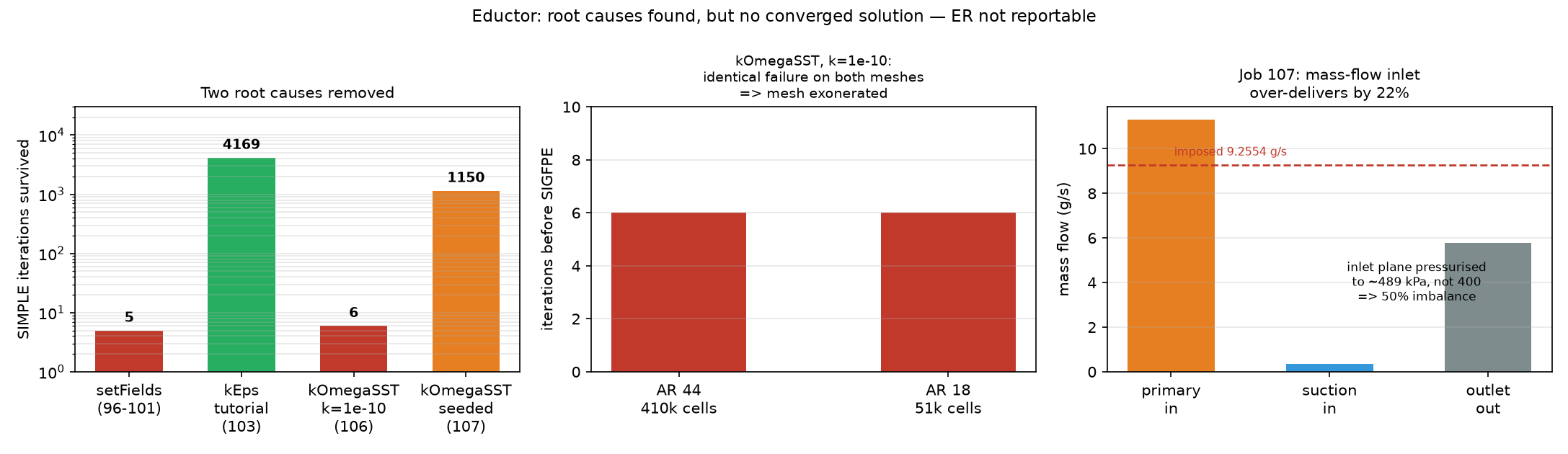
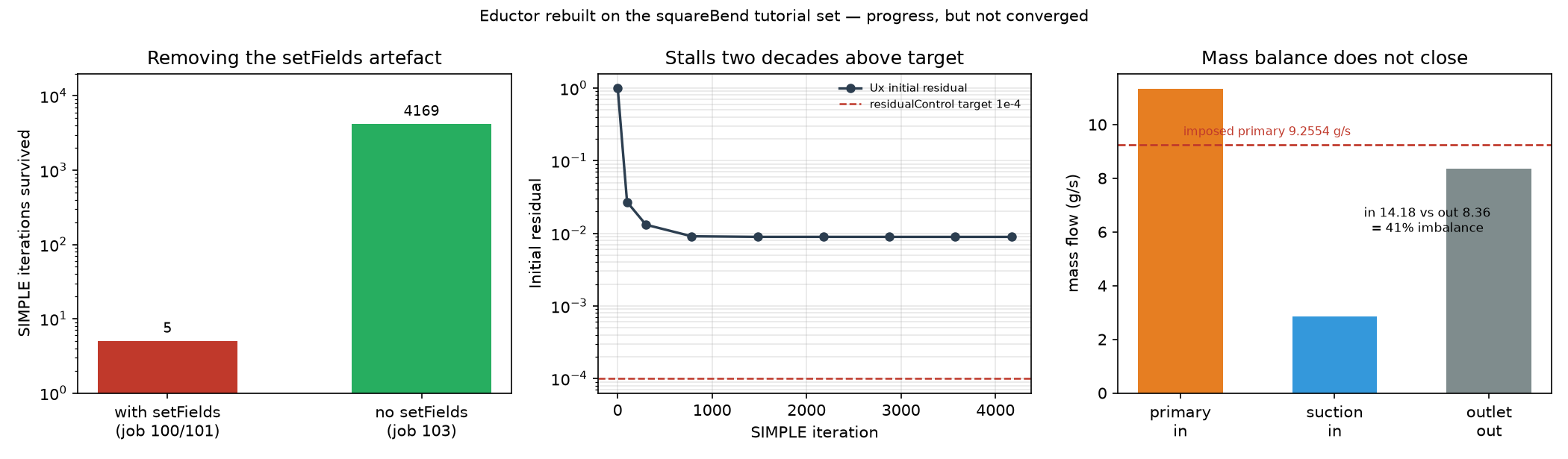
The staged CFD case reached 410,400 cells, but mass imbalance remained around 50%. The useful output was the failure diagnosis and a proposed next solver test.
No accepted entrainment ratio. A transient-solver alternative was proposed but not run successfully in this record.
The recorded investigation
Build the OpenFOAM setup
The record develops a specialist and a steady compressible RANS case with a k–ω SST turbulence model.
Challenge the mesh explanation
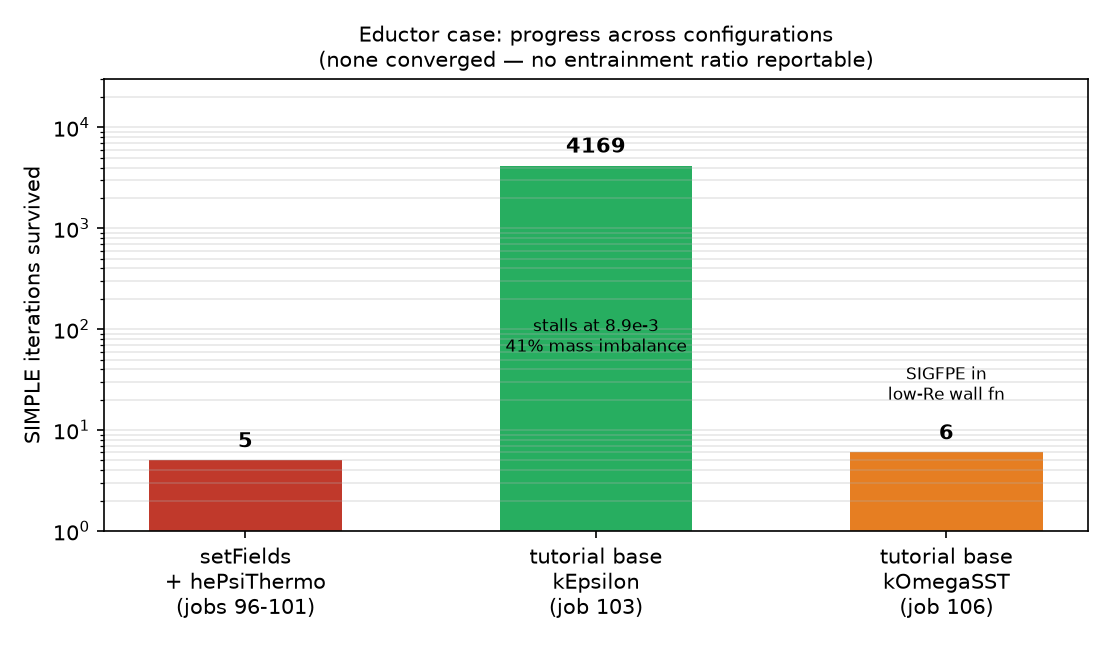
A 51,300-cell coarse case also fails, weakening the claim that fine-grid geometry alone explains the problem. The proposed very large remesh was not executed.
Improve numerical survival without accepting the answer
After revised turbulence initialization, one reported run reaches about 1,150 iterations but still fails. Residuals and mass balance remain unacceptable.
Preserve the diagnosis and next proposal
The final staged case has 410,400 cells. A transient solver and inlet-boundary revision are proposed next, not demonstrated as successful.
Where the conclusion stops
- The conversation is marked completed, but the CFD investigation is unresolved. No entrainment ratio is accepted.
- The source report contains earlier hypotheses alongside later addenda; the later diagnostic evidence weakens the initial mesh-only explanation.
- The transient-solver alternative is a proposal, not an executed successful follow-on.
- Source review raised compute-authorization issues. This record is not proof of unattended spend control.
The next useful test
Review the boundary conditions, then authorize and validate a bounded transient test with explicit convergence and mass-balance acceptance criteria.
Selected scientific files
These files support inspection of the study. They are not a complete package of run inputs, dependencies or raw outputs. Scientific scripts are provided for reading; this website does not execute them.
- config_progress.png
- diagnosis_final.png
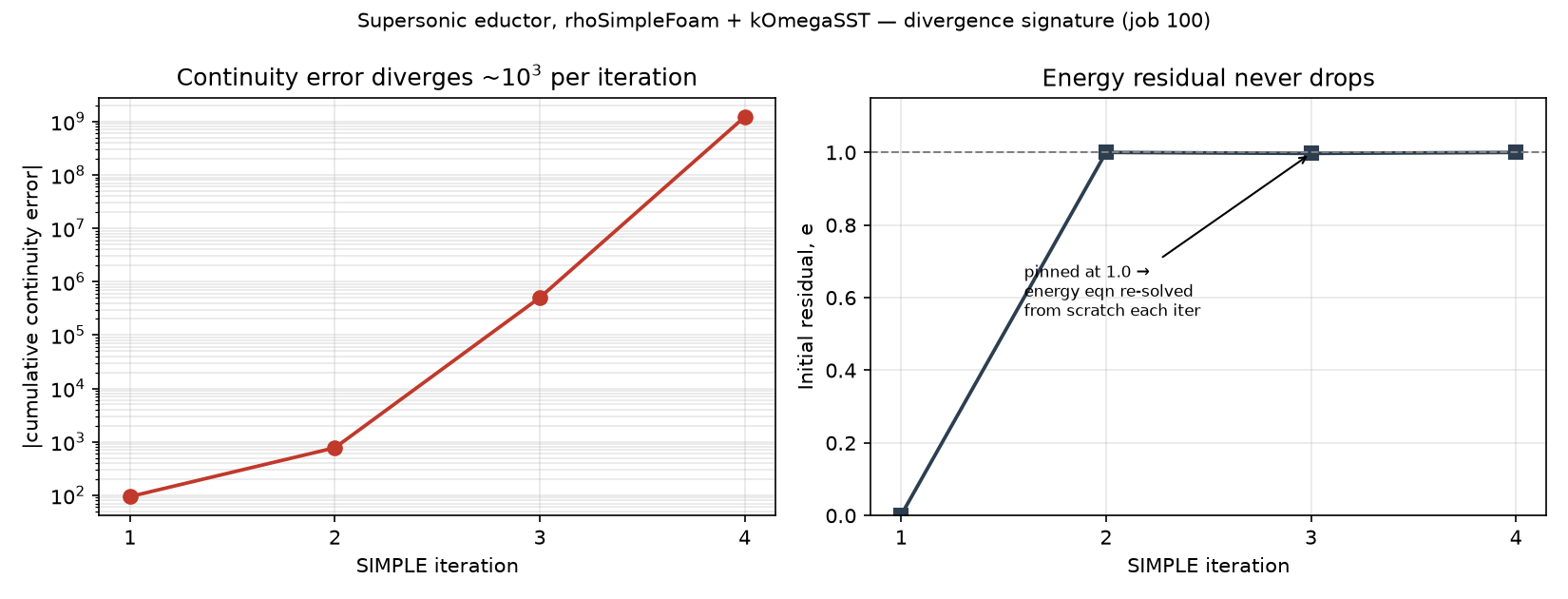
- divergence_signature.png
- eductor_case_spec.json
- tutorial_rebuild.png
This is an editorial evidence summary of a recorded investigation, including later requests and review. The prompt animation is a presentation of saved work, not a live simulation. Human time saved was not measured.