Aerospace engineering · evidence summary
A fixed assumption hides a lighter part of the design space.
The user initially asked for an open-source 2D CFD program for compressor and turbine blades. The task evolved into designing a hot pressurised-air supply: 2–10 tonnes per hour, 2–4 bar absolute, at 50,000–60,000 feet and Mach 0.7–0.9, with zero net installed thrust. The practical question became which system architecture could meet the envelope at low mass and fuel demand.
The research prompt
Original research prompt
the design space is (1) total air flow 2ton/hr to 10ton/hr (2) altitude 50,000feet to 60,000feet (3)2bar to 4 bar (4)mach 0.7 to 0.9; optimizioan should be on total mass and/or fuel; no need to cool the pressurzied air generated; add some 3D visualziation, the report should read as an optimization report that generate and explain what is the best system
65.8% lower modelled mass proxy.
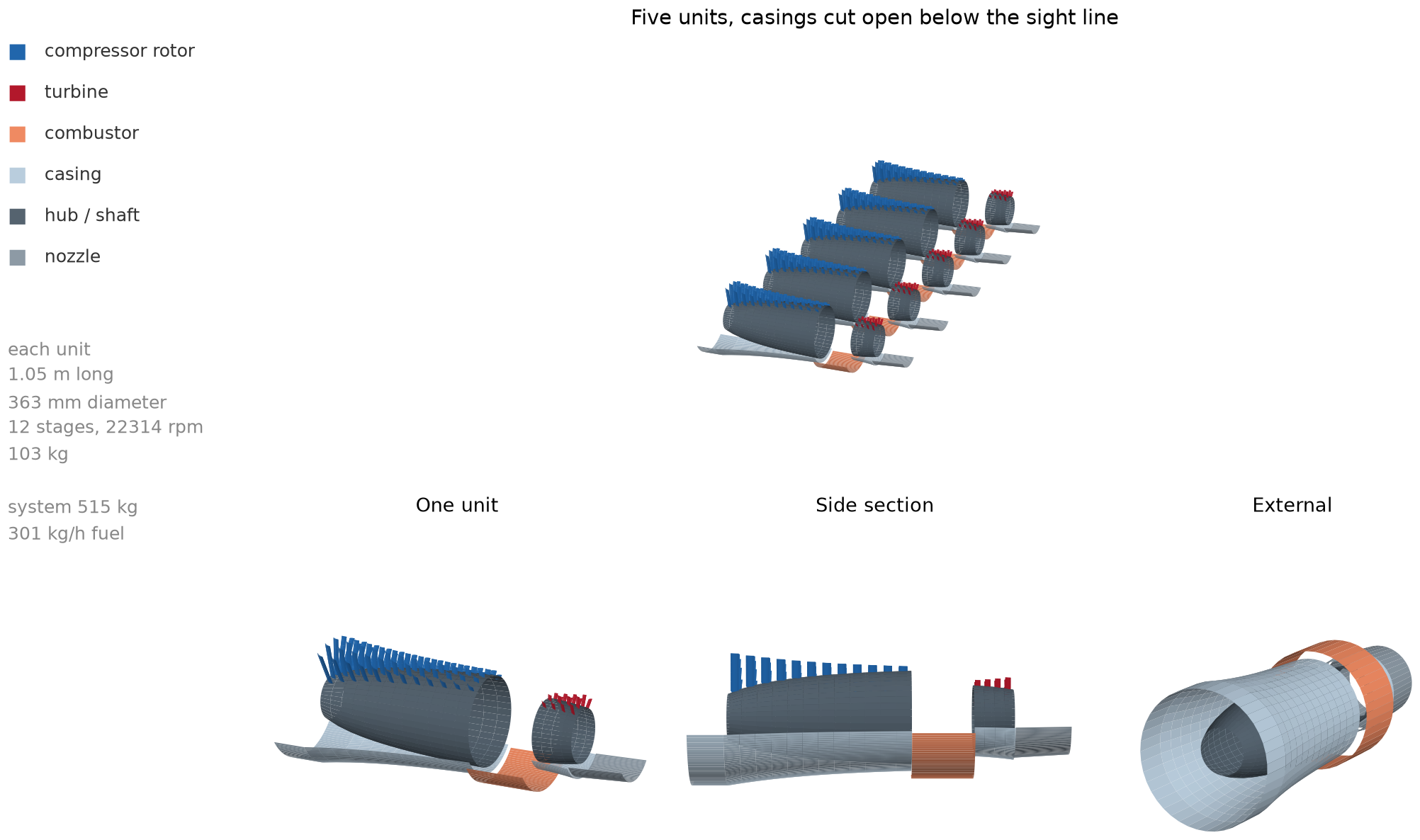
A reduced-model search screened 45.16 million candidate grid points. Variable stage loading reached 515.2 kg versus 1,505.5 kg with fixed loading.
Reduced-model screening, not 45 million CFD runs. The mass proxy excludes fixed per-unit overhead and requires higher-fidelity checks before a hardware decision.
The recorded investigation
First, check whether the requested approximation fits
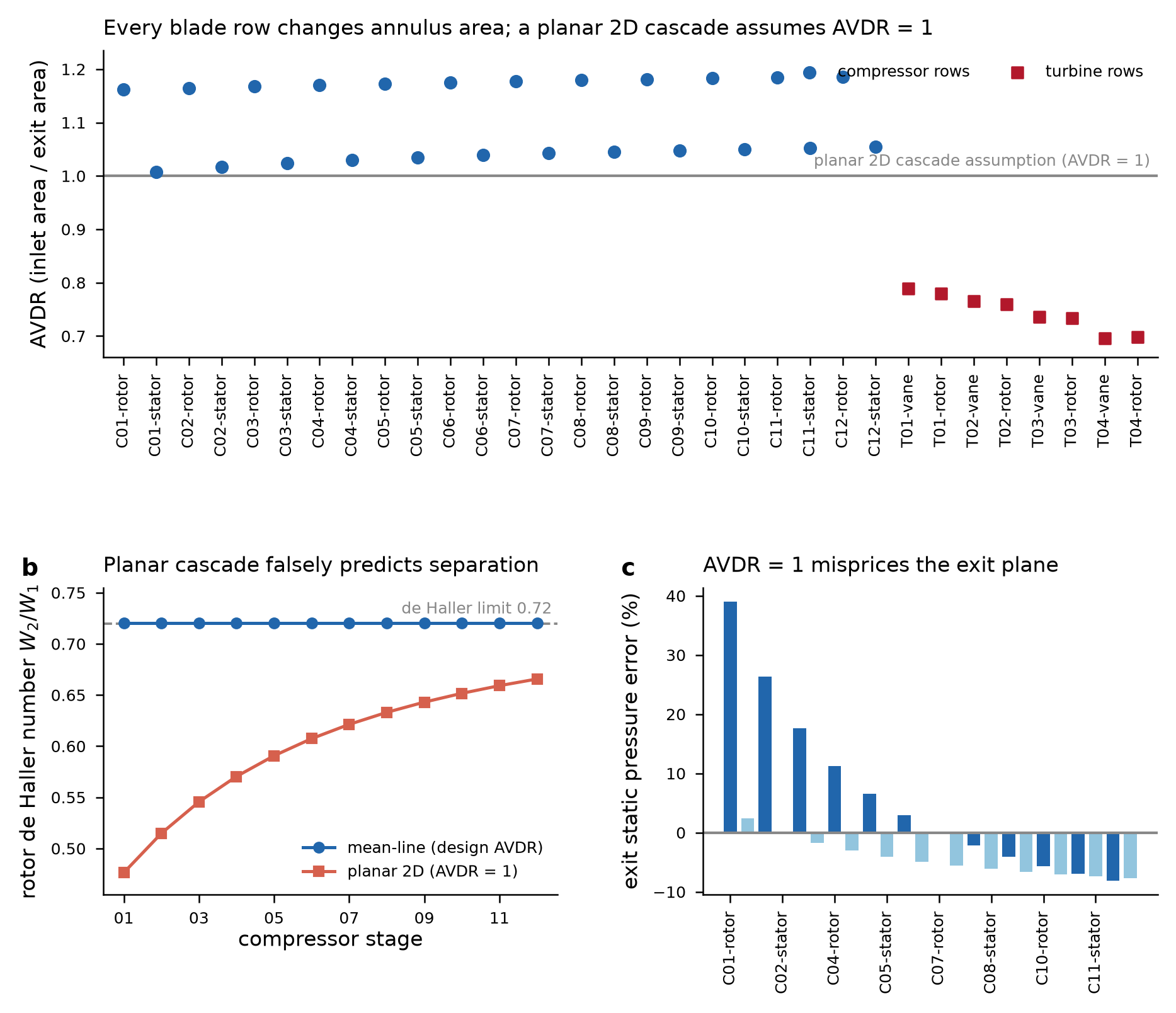
Laplace compared tools, generated boundary conditions and tried SU2. It found that a planar cascade's constant stream-tube area could badly misrepresent the rotor rows inherited from the design package. No conservation-verified loss coefficient emerged. That early work gave a useful handoff and a reason to select the next model carefully, rather than a validated CFD answer.
Turn the changing brief into a searchable model
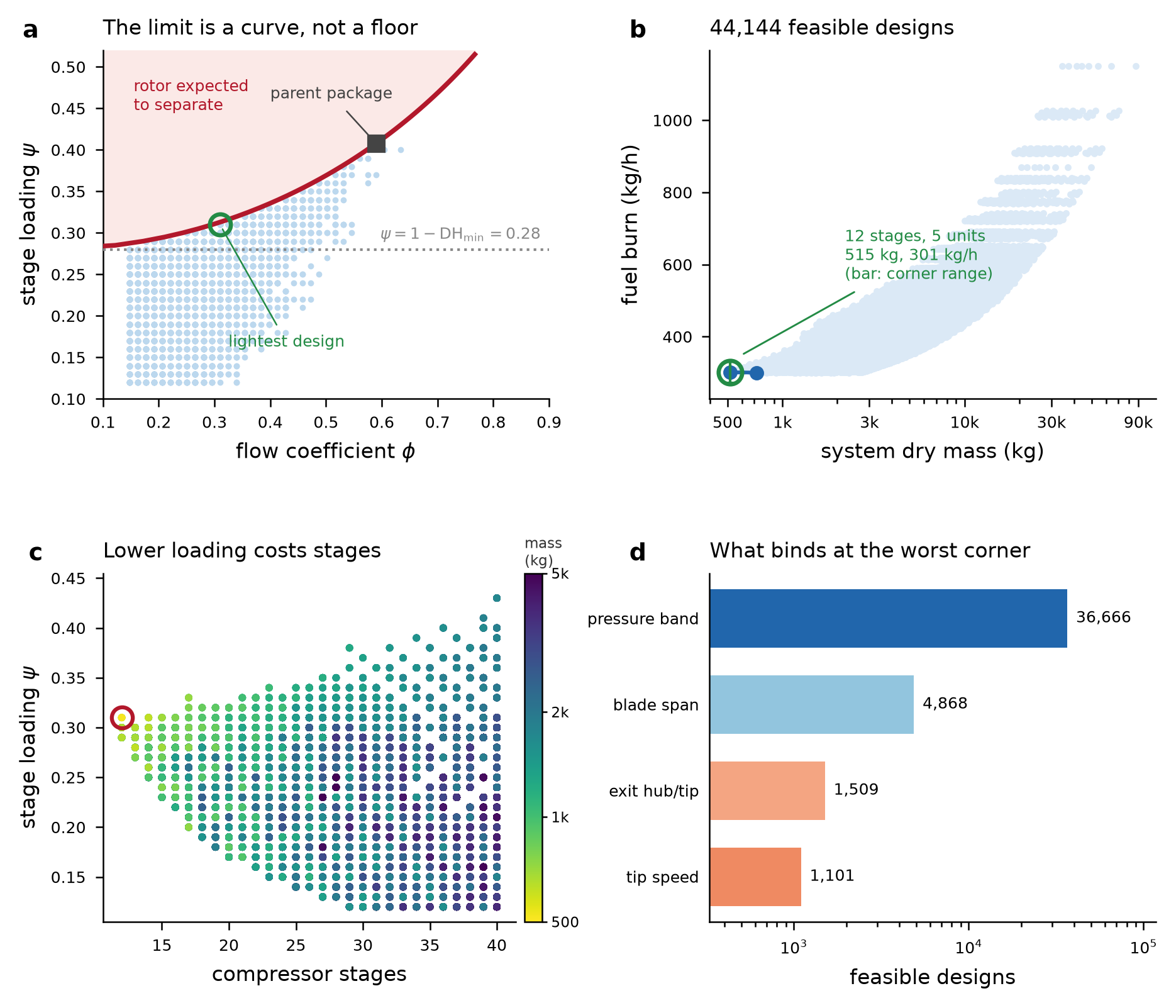
The user then expanded the study to a system design and operating envelope. Laplace built cycle and geometry calculations, parameter sweeps and constraint checks. The final campaign screened 45,158,400 candidates in stage count, unit count, flow coefficient, stage loading and blade speed. Its grid contains 44,144 designs that pass the model's checks at eight mission-box corners.
Quantify the lever, and correct the explanation
Allowing stage loading to vary gives a minimum mass proxy of 515.2 kg, compared with 1,505.5 kg when it is frozen at the inherited value: 65.8% lower within this model. Review also forced a more important correction. Frozen loading still admits 20 feasible designs. The missing variable buys lower modelled mass; it does not explain the earlier infeasibility verdict, whose cause remains unidentified.
Where the conclusion stops
- The 65.8% comparison is between two searches within the same reduced model. The mass proxy excludes mounting, ducting, controls and other fixed unit overhead; it is not a manufactured weight or customer saving.
- The 515 kg concept clears the tightest constraint by about 0.20%, smaller than important modelling uncertainties. It is not a robust or flight-ready design.
- The final report excludes 3D flow effects, blade-to-blade aerodynamics and rotordynamics. The initial SU2 run did not yield a conservation-verified loss prediction.
- The report withdraws an old five-minute runtime claim. It reports a measured 2.23 ms/candidate/core and an estimated 28 hours on two cores for the full grid; full cluster wall time is not established. The original code header retains stale timing comments.
- The final 6d 23h 15m session span includes multiple redesign requests, human steering and review. It is not a duration for the initial tool-selection question alone.
The next useful test
Use the study to shortlist concepts and choose what to validate at higher fidelity. Add realistic unit overhead, mechanical and rotordynamic analysis, and blade-level aerodynamics before selecting hardware. The lightest grid point is a boundary candidate, with only about 0.20% margin on its tightest modelled constraint.
Selected scientific files
These files support inspection of the study. They are not a complete package of run inputs, dependencies or raw outputs. Scientific scripts are provided for reading; this website does not execute them.
- avdr_screening.png
- design_space.csv
- design_space.png
- driver.py
- frozen_psi_search.csv
- key_numbers.json
- system_3d_rec.png
This is an editorial evidence summary of a recorded investigation, including later requests and review. The prompt animation is a presentation of saved work, not a live simulation. Human time saved was not measured.