Surface physics · evidence summary
Why does water bead more strongly than the chemistry predicts?
An engineer wants to know how water should wet silica coated with trimethylsilyl groups. A contact angle describes how much a drop beads up: a larger angle means less spreading. A single answer matters less than knowing which physical lever controls it. Should the team change the coating chemistry, remove more hydroxyl groups, or change how the particles are deposited?
The research prompt
Original research prompt
assume silica coated with TMMS, estimate its contact angle with water from first prinicipple (without quoting observation); start with analytical model
A texture hypothesis to test.
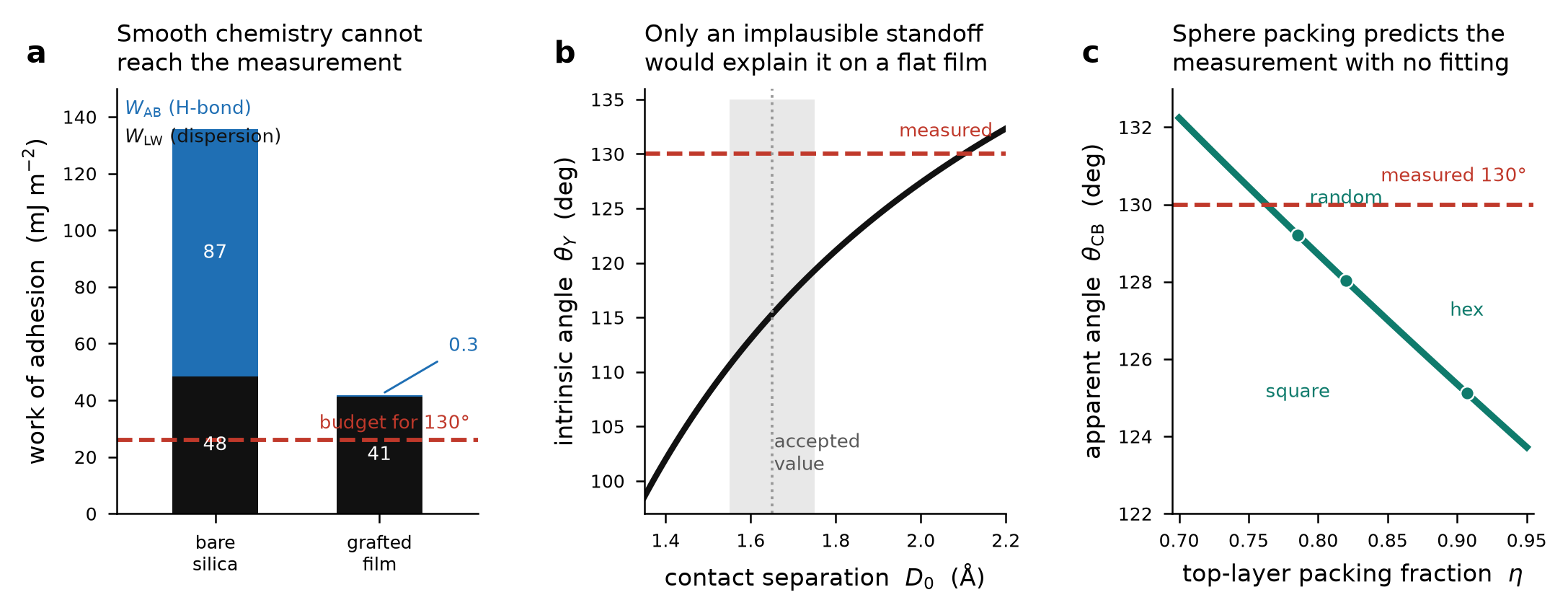
The analytical coating model gave 115.3°. After the user supplied a 130° measurement, the study examined how particle packing could explain the gap.
Analytical and geometric models. The 130° measurement was disclosed before the texture explanation; this was not a blind prediction.
The recorded investigation
Start from chemistry rather than fitting the angle
The initial request was to estimate the angle from first principles, starting analytically. Laplace assembled a dispersion-force model, built a geometric coating, and estimated which leftover hydroxyl groups a water molecule could reach. The early report gave about 116°; the final refined baseline is 115.3°. It used known material properties and an empirical contact-separation parameter, without using an input contact-angle measurement. The exact final baseline should not be read as a timestamped prediction made before every later revision.
Find the mechanism hidden by a surface-chemistry count
The model leaves about 39% of hydroxyl sites unreacted because the coating groups physically crowd one another. What matters is accessibility: the coating shelters the remaining sites. In the model, making those sites accessible would lower the angle to 87.8°. That gives the team a concrete hypothesis: changing the chemical count alone may miss what water actually encounters.
Use a discrepancy to change the question
The user then disclosed a measured angle of 130°. Laplace examined a textured bed of silica spheres rather than forcing the smooth-surface model to fit. Assuming water is suspended on the sphere tops, the model gives 125.1–129.2° across the considered packings. The useful output is an explanation to test: particle packing and trapped air may account for the difference between the chemistry and the measurement.
Where the conclusion stops
- The assumed contact separation is a major uncertainty: the report gives a 98.6–125.9° intrinsic-angle range over its wider parameter interval. The baseline 115.3° is not a high-precision accuracy claim.
- The 130° measurement was disclosed before the textured-surface explanation was developed. Agreement is post-disclosure consistency, not independent predictive validation.
- The suspended wetting state and sample packing were not directly observed. Static geometry omits thermal motion and does not predict hysteresis.
The next useful test
Test the proposed wetting state before changing the chemistry. Advancing/receding contact angles or a tilt test can probe pinning and hysteresis; microscopy can constrain the packing fraction. These are proposed experiments, not completed validation.
Selected scientific files
These files support inspection of the study. They are not a complete package of run inputs, dependencies or raw outputs. Scientific scripts are provided for reading; this website does not execute them.
This is an editorial evidence summary of a recorded investigation, including later requests and review. The prompt animation is a presentation of saved work, not a live simulation. Human time saved was not measured.